AdmiScan Research · Master's Admissions
A Strong Profile Isn't Enough
What 4,000+ Master's programmes reveal about the eligibility rules students miss
A student can have a 9/10 academic record, a strong GRE score and an IELTS 8 and still be applying to the wrong Master's programme. Universities admit applicants to specific programmes, and those programmes can impose academic background rules that disappear inside conventional university rankings.
Research snapshot
4,009
verified, catalogue-ready Master's programmes analysed
3,759
programmes with classifiable undergraduate-background evidence
3 countries
USA, UK and Germany
The first question is not "What are my chances?"
A more basic question comes first: does the programme actually accept your academic background? Admission probability is irrelevant if the programme requires a degree background, prerequisite or academic foundation that the applicant does not have.
AdmiScan therefore separates background eligibility from competitive admission probability. This report examines the former.
What the country comparison shows
| Country | Research programmes | Classifiable backgrounds | Explicit any-discipline | Related/relevant field | Any-discipline share | Unknown share |
|---|---|---|---|---|---|---|
| USA | 2,715 | 2,587 | 124 | 2,362 | 4.79% | 4.71% |
| Germany | 729 | 637 | 7 | 586 | 1.10% | 12.62% |
| UK | 565 | 535 | 66 | 347 | 12.34% | 5.31% |
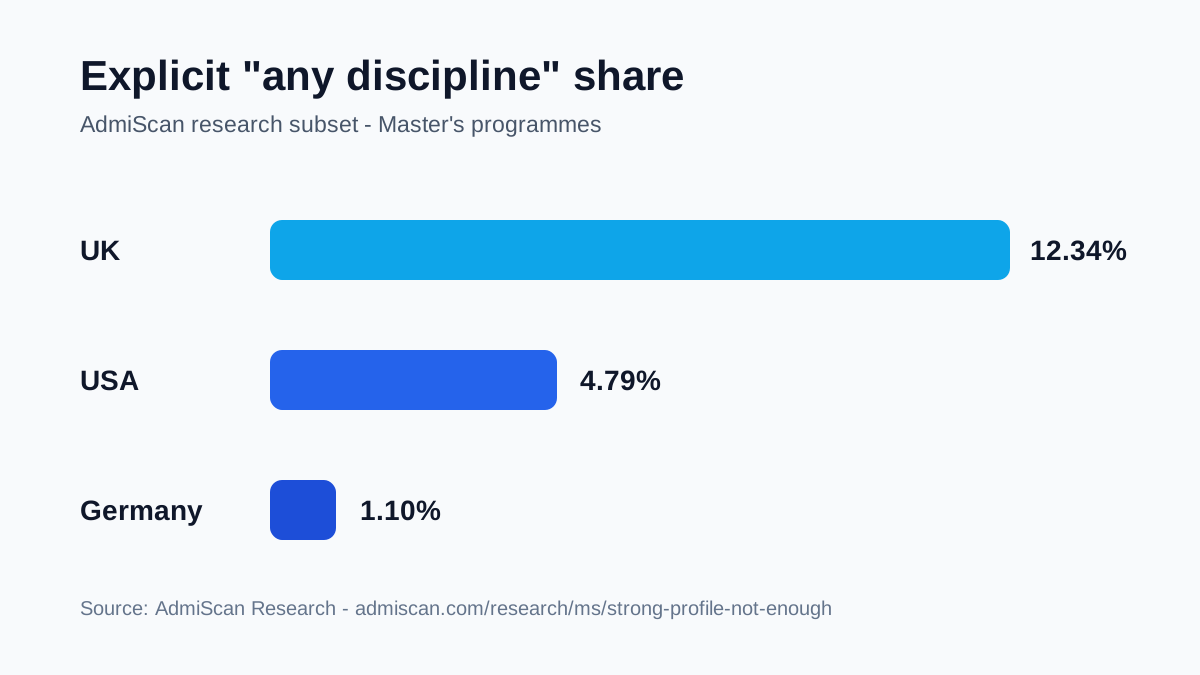
The UK had the highest explicit "any discipline" share in this research subset at 12.34%. The USA was 4.79%, while Germany was 1.10%.
That does not mean the USA and Germany are simply "less flexible". Their programme descriptions much more often used related or relevant-field requirements. An applicant from a neighbouring discipline may still be eligible, but that is different from a programme explicitly accepting any academic discipline.
Why we do not merge "any discipline" and "related field"
Those are semantically different requirements. A programme that accepts any discipline is not making the same claim as one that accepts only related or relevant academic backgrounds. Combining them into one broad "flexibility" statistic can make the data sound more permissive than the programme language actually supports.
Germany also had the largest unresolved-background share
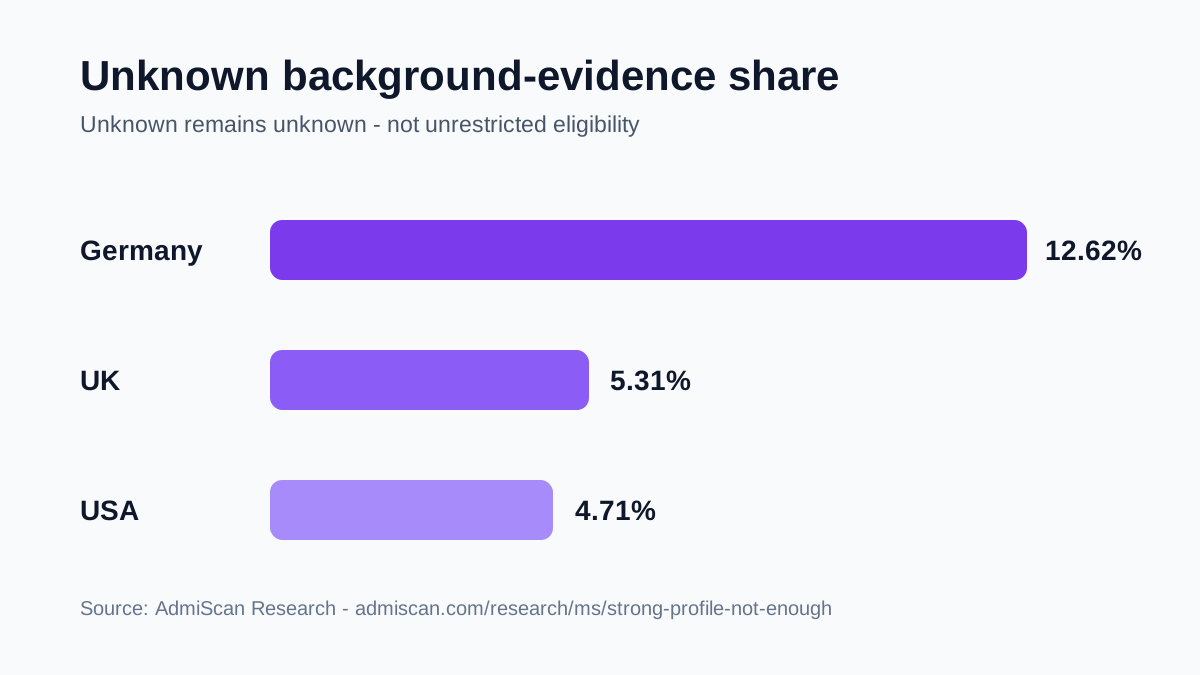
In this subset, 12.62% of German programmes remained unknown for the undergraduate-background classification, compared with 5.31% in the UK and 4.71% in the USA.
AdmiScan does not interpret that as "no background requirement". Unknown remains unknown until stronger programme-level evidence is available.
What students should do before paying an application fee
- 1. Verify the exact programme. University-level reputation does not replace programme-level eligibility.
- 2. Check accepted academic backgrounds. Look for explicit degree or subject requirements.
- 3. Check prerequisites. Mathematics, programming, statistics, economics or other coursework may matter independently of the degree title.
- 4. Separate eligibility from competitiveness. Being allowed to apply is not the same as being likely to receive an offer.
- 5. Keep unresolved facts unresolved. Do not assume that an absent statement means a requirement does not exist.
Methodology
This report uses a research subset of 4,009 Master's programmes that were both verified and catalogue-ready in AdmiScan's structured programme data. Of those, 3,759 had undergraduate-background evidence that could be classified for this analysis.
Country totals in the research subset were 2,715 programmes in the USA, 729 in Germany and 565 in the UK. The analysis keeps explicit "any discipline" language separate from "related/relevant field" language and preserves unknown cases rather than treating them as negative or unrestricted requirements.
Cite / Download / Embed
Reuse this research with attribution
These research assets are provided so journalists, student publications, counsellors and researchers can reference the findings without reconstructing the numbers. Please cite the canonical AdmiScan report and preserve the distinction between explicit any-discipline requirements, related/relevant field requirements and unknown evidence.
Suggested citation
AdmiScan Research. "A Strong Profile Isn't Enough: What 4,000+ Master's Programmes Reveal About the Eligibility Rules Students Miss." 6 October 2026. https://admiscan.com/research/ms/strong-profile-not-enough
Shareable research charts
The charts below can be linked or embedded with attribution to the canonical AdmiScan research page.
Embed example
<a href="https://admiscan.com/research/ms/strong-profile-not-enough">
  <img src="https://admiscan.com/research/ms/strong-profile-not-enough-any-discipline.svg"
       alt="AdmiScan Master's programme eligibility research" />
</a>
<p>Source: AdmiScan Research</p>
Limitations
- - This is not a census of every Master's programme in the three countries.
- - Programme requirements can change by intake.
- - Related-field eligibility can still depend on programme-specific prerequisites.
- - The analysis does not estimate admission probability.
- - Unknown cases are intentionally retained rather than forced into a category.
Suggested citation:AdmiScan Research. "A Strong Profile Isn't Enough: What 4,000+ Master's Programmes Reveal About the Eligibility Rules Students Miss." 6 October 2026. https://admiscan.com/research/ms/strong-profile-not-enough
For media or academic reuse, cite the canonical report URL and preserve the distinction between explicit any-discipline requirements, related-field requirements and unknown evidence.